IBERIAN HAM
WHAT TO CONSIDER WHEN BUYING IBERIAN HAM OR AN IBERIAN SHOULDER
When buying Iberian ham (jamón ibérico) there are many factors to weigh up in order to choose the best one. By best, I do not mean the best in terms of quality alone, but the best value for money that each consumer can afford when buying this exquisite delicacy of the Iberian Peninsula.
We say Iberian Peninsula because the pigs that both hams and shoulders come from must be from this region, where the pig breed is native, and must be born, raised, fed, slaughtered and processed in line with current regulations for the hams and shoulders to be considered Iberian.
In Spain many producers make this exquisite delicacy and each has its own hallmark, but four designations of origin always deserve a mention: PDO Guijuelo, PDO Jabugo, PDO Los Pedroches and PDO Dehesa de Extremadura. These Protected Designations of Origin cover the areas where the finest Iberian hams are made, with the provinces of Huelva, Córdoba, Seville, Badajoz, Cáceres and Salamanca being the best for producing and curing this product.
Below we explain a few small details worth bearing in mind when buying Iberian ham online or an Iberian shoulder ham.
To begin with, we will explain what Iberian hams and shoulders are, the types that exist and the factors to consider when buying them.
Differences between an Iberian ham and an Iberian shoulder
When buying online, whether a ham or a shoulder, we always ask ourselves which is better, and we are not quite sure which to buy. This is mainly down to a lack of information about these products, because a ham is a ham and a shoulder is a shoulder. They are completely different products in shape, size, flavour, aroma, weight, meat yield, ease of slicing, curing and price per kg, among many other factors. Below we give you some information on all of this, so that you can choose the best ham or shoulder for your needs.
What is an Iberian ham?
Iberian hams are hams from the hind legs of pigs with a minimum Iberian breed purity of 50%, and they must be certified by a certification body to guarantee that purity.
That is why there are 50% Iberian, 75% Iberian and 100% Iberian hams on the market, which, depending on their feed, give rise to different types of ham, as we will show below.
The cross can be made with different breeds, the Duroc pig being the most common because of its excellent fat infiltration and greater weight.
As a general rule, the greater the Iberian breed purity of the pig, the slimmer the legs and the finer the shank, helped by the daily exercise the animal gets.
What is an Iberian shoulder ham?
Iberian shoulder hams (paletas) are the shoulders from the front legs of pigs with a minimum Iberian breed percentage of 50%. As with hams, depending on their breed purity, there are 50% Iberian, 75% Iberian and 100% Iberian shoulders.
These shoulders differ from Serrano ones in being slimmer and having a finer shank, the higher the Iberian breed purity of the pig and the more exercise it gets during its life.
Types of Iberian hams and Iberian shoulder hams
The types of Iberian ham are classified according to Royal Decree 4/2014 of 10 January, approving the quality standard for Iberian meat, ham, shoulder and loin as follows:
Types of Iberian hams
The types of Iberian ham are classified according to two key parameters: the pig's feed and its breed purity. However, to obtain the relevant labelling they must pass many more checks, such as the pig's age in months, slaughter dates, carcass weight, minimum curing time and so on.
Below we briefly explain the different types by breed purity and feed:
100% Iberian Acorn-Fed Ham (black label)
This ham comes from 100% Iberian pigs fed during the montanera (the acorn-feeding season) on acorns, grass and other natural resources of the dehesa (Spanish oak pasture). It is the jewel in the crown and the one producers usually choose for hams under a Protected Designation of Origin, as it is the highest quality.
For those nostalgic for the old terminology, we are talking about pure Iberian acorn-fed ham, which is the only one that can currently be called pata negra ham.
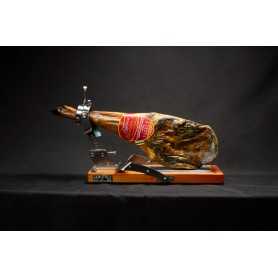
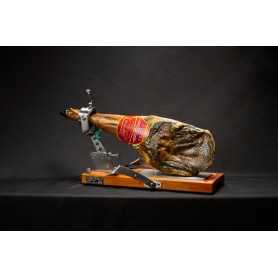
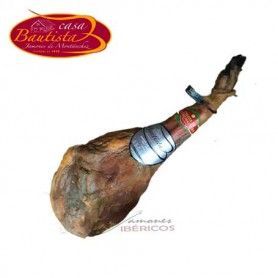
Another distinguishing feature is the hoof, usually black, which shows considerable wear from the long walks the pig takes across the dehesa to feed and to drink at the available watering places.
These pigs are given a minimum number of hectares, depending on the production and quality of acorns from the holm oaks of the dehesa, where they take part in the montanera.
75% Iberian Acorn-Fed Ham (red label)
It is very important to tell a 75% Iberian ham from one with 50% Iberian breed. Do not let anyone pull the wool over your eyes, because the quality is not the same: in any case the 75% is superior, having a higher Iberian breed purity.
These hams come from pigs whose mother has a breed purity of 50% and whose sire is 100% (a pure Iberian pig), fed during the montanera on acorns, grass and other natural resources of the dehesa. They have a fuller bouquet and aroma than the 50% Iberian.
As with 100% Iberian acorn-fed hams, the pieces are slim, with a slightly less fine shank and a hoof that is usually black, showing the wear from the walks and journeys the pigs make across the dehesa in search of water and the acorns they feed on.
These pigs are given a minimum number of hectares, depending on the production and quality of acorns from the holm oaks of the dehesa, where they take part in the montanera.
50% Iberian Acorn-Fed Ham (red label)
These hams have almost the same characteristics as the 75% Iberian ones, although the quality is lower because of the lower breed percentage. The mother is usually a Duroc and the sire a 100% Iberian (a pure Iberian pig), fed during the montanera on acorns, grass and other natural resources of the dehesa.
As the Iberian breed purity falls, the slimness of the leg decreases, although because they feed in the dehesa during the montanera they are still very slim.
In any case these hams are very slim, but with a slightly less fine shank than the 75%, and a usually black hoof worn down by the walks through the dehesa in search of food and water during the montanera.
Free-Range Iberian Ham, "Cebo de Campo" (green label)
Free-range Iberian hams ("cebo de campo") come from Iberian pigs, normally reared extensively on the resources of the dehesa or the countryside, as well as on feed made up mainly of cereals and legumes. The pig they come from can be 50%, 75% or 100% Iberian.
In our opinion, these hams normally offer the best value for money. The price is usually close to 50% lower than an Iberian acorn-fed ham, and they come from pigs raised in freedom on extensive farms. This gives them plenty of space to feed and exercise, achieving good fat infiltration, and on many occasions they can even feed on acorns left over by the acorn-fed pigs.
These hams can come from Iberian pigs of any breed percentage above 50% (usually 50%), so they will be more or less slim depending on it, with a more or less fine shank. The hoof will usually be black, with the wear depending on the exercise the animal has done, which is why we always advise choosing the ham with the most worn hoof.
Grain-Fed Iberian Ham, "Cebo" (white label)
This is the lowest quality ham within the range of Iberian hams. It comes from Iberian pigs fed on feed made up mainly of cereals and legumes on intensive farms. The pig it comes from can be 50%, 75% or 100% Iberian, with the breed purity usually being close to 50%.
This is still a quality ham, even though it is the lower end of the Iberian range. These hams are less slim than the rest because, although breed purity influences slimness, being fed intensively the animals do not have the space to move around and take the daily exercise that makes them so slim. This lack of exercise makes them less slim, with a thicker shank than the previous ones. In addition, the fat infiltration is lower and the flavour and aroma are less pronounced than in the other types, where natural feeding gives them unique, exquisite flavours.
Types of Iberian shoulder hams
To keep things short, you can apply the same concepts as for hams to shoulders, so we will only classify Iberian shoulders by feed and breed percentage, without going into lengthy explanations.
100% Iberian Acorn-Fed Shoulder Ham (black label)
Shoulder from 100% Iberian pigs fed during the montanera on acorns, grass and other natural resources of the dehesa. It corresponds to the former pure Iberian acorn-fed shoulder, and is the only one that can be called a pata negra shoulder.
75% Iberian Acorn-Fed Shoulder Ham (red label)
Shoulder from pigs whose mother has a breed purity of 50% and whose sire is 100% (a pure Iberian pig), fed during the montanera on acorns, grass and other natural resources of the dehesa. It has a fuller bouquet and aroma than the 50% Iberian.
50% Iberian Acorn-Fed Shoulder Ham (red label)
Shoulder from pigs whose mother is usually a Duroc and whose sire is a 100% Iberian (a pure Iberian pig), fed during the montanera on acorns, grass and other natural resources of the dehesa.
Free-Range Iberian Shoulder Ham, "Cebo de Campo" (green label)
Shoulder from Iberian pigs, normally reared extensively on the resources of the dehesa or the countryside, as well as on feed made up mainly of cereals and legumes. The pig it comes from can be 50%, 75% or 100% Iberian.
Grain-Fed Iberian Shoulder Ham, "Cebo" (white label)
Shoulder from Iberian pigs fed on feed made up mainly of cereals and legumes on intensive farms. The pig it comes from can be 50%, 75% or 100% Iberian.
Meat yield of Iberian ham and shoulder
A factor well worth considering when choosing a ham or a shoulder is its meat yield, which is higher in the ham than in the shoulder, with an average difference of 5%:
|
Ham |
Shoulder |
| Grain-fed Iberian |
36% - 44% |
31% - 40% |
| Free-range Iberian |
36% - 44% |
31% - 40% |
| Acorn-fed 50% Iberian |
36% - 42% |
30% - 35% |
| Acorn-fed 75% Iberian |
36% - 42% |
30% - 35% |
| Acorn-fed 100% Iberian |
35% - 40% |
28% - 33% |
This difference often means that, when we buy an Iberian shoulder for the first time, it feels as if it has a lot of fat and bone and little meat to carve.
How to carve a ham or a shoulder?
We want to stress this point: slicing a ham is completely different from slicing a shoulder. Because of the shape of the bone in each piece, slicing a ham is easier than slicing a shoulder for non-professional ham carvers, making it possible to make better use of its meat yield.
Is there much of a price difference between an Iberian ham and an Iberian shoulder?
The answer is yes. The price per kg of Iberian ham is usually more than 30% higher than the price per kg of Iberian shoulder of the same type. So, given that the yield of a ham is 5% to 13% higher than that of a shoulder, and the price difference is usually over 30%, we can say that buying a shoulder is better value than buying an Iberian-breed ham.
On the other hand, slicing a shoulder is much more difficult, so if you choose a shoulder, we recommend always choosing the heaviest one.
So: should you buy Iberian ham or a shoulder?
We can say that these are two completely different products, whose meat is not the same. Ham has a milder flavour than the shoulder, whose aroma and flavour are more intense because the meat is closer to the bone.
On the other hand, as we have explained, the meat yield is different and so is the price, two very important factors when making your choice.
If we add that carving a ham is different from carving a shoulder, where slicing is more complicated, we can say that, if the difference in flavour does not matter to us and we know how to slice well, the shoulder offers better value for money, but if we are not very good at slicing, a shoulder will be harder to slice properly and get the most meat from, so in this case we recommend hams.